
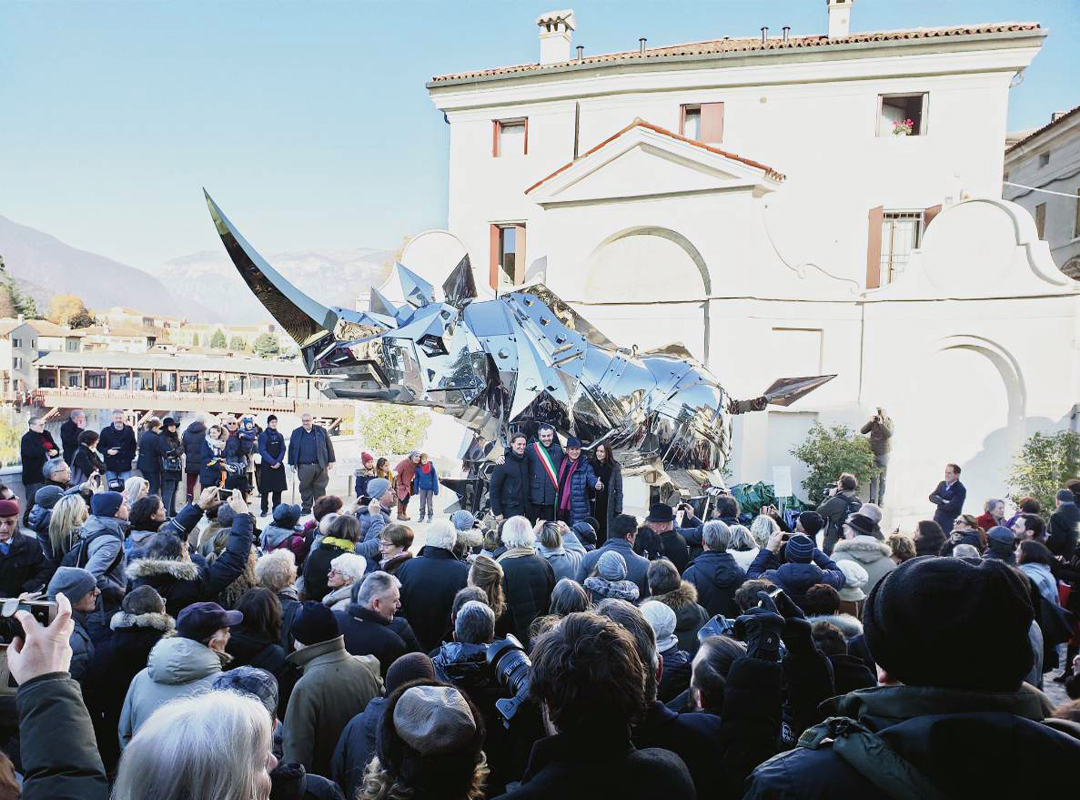
The Taiwanese sculptor reflects on material, time, cultural memory, and the ethical presence of art in an age of ecological uncertainty.
Encountering the work of SHIH Li-Jen is not only an encounter with sculpture, but with a long, quiet attention to civilization itself.
Over decades, Shih has developed a highly recognizable sculptural language centered on a recurring figure: the rhinoceros.
Rather than functioning as a naturalistic animal image, the rhinoceros becomes a vehicle for questions—about strength and restraint, disappearance and survival, and the moral cost of progress.
Q. How did the rhinoceros first enter your work? Was it an aesthetic decision or a lived experience?
The rhinoceros was not something I “set” from the beginning. It appeared gradually through the act of making—through sculpture, observation, and time.
As I worked, I kept returning to a certain feeling: the rhinoceros holds strength, yet it also carries a kind of gentleness. Those two qualities can seem contradictory, but they coexist.
The rhinoceros has existed long before human civilization, yet it has become fragile because of the values and desires humans project onto it. That reality stayed with me and became difficult to ignore.
So when I work with the rhinoceros, I am also thinking about how civilization deals with power, restraint, and coexistence.
Q. You have said your rhinoceros is not a literal animal. How do you define its role in your work?
I’m not approaching it as zoology.

Across many cultures, animals once mediated the relationship between humans and larger forces—nature, time, the cosmos. In my work, the rhinoceros becomes a contemporary totem: a form through which we can reflect on our condition.
It mirrors something about our era—immense technological power, and at the same time ethical uncertainty.
Q. Before devoting yourself fully to sculpture, you founded and ran a gallery. How did that experience shape your thinking?
That experience gave me perspective rather than authority.
I saw how artworks circulate, how meaning can be built and simplified, and how easily “visibility” can replace depth. It made me trust time more than commentary.
When I returned fully to sculpture, I stopped thinking about trends. I wanted to make works that remain—works that still hold, even when their immediate context is gone.
Q. Material is central to your practice. How do you choose materials?
Materials carry history and weight.
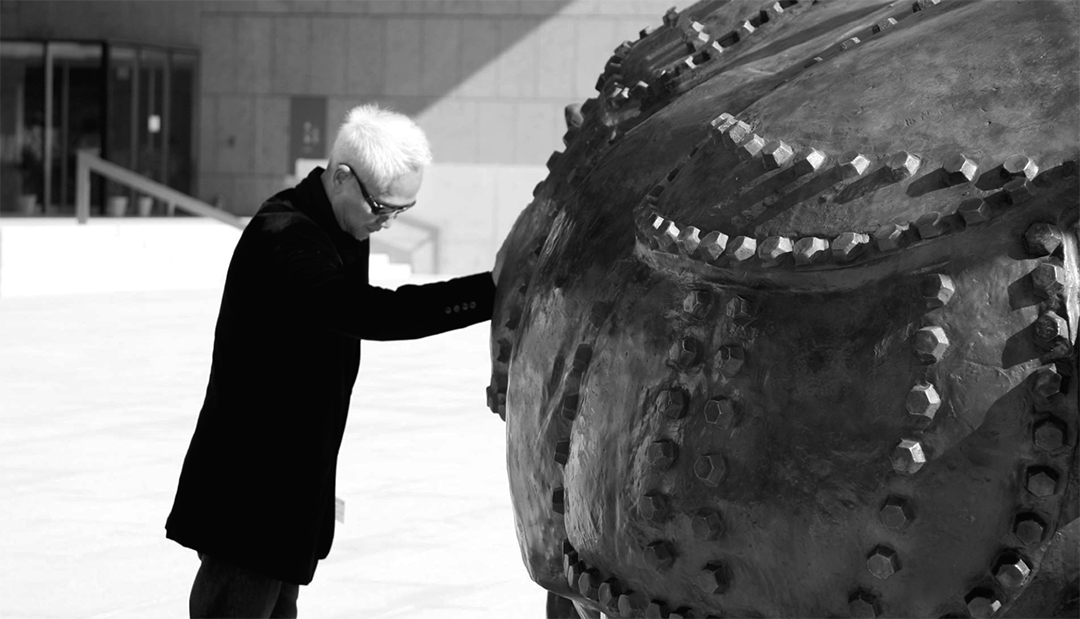
Bronze, steel, and industrial metals have been used for monuments, tools, weapons, and infrastructure. I work with them not for surface effect, but because they already hold traces of time and use.
For me, sculpture must have weight in order to stand with time. Material is not decoration—it is what allows a work to stay.
Q. Time seems to recur in your work. How do you understand its role?
Sculpture and time are inseparable.
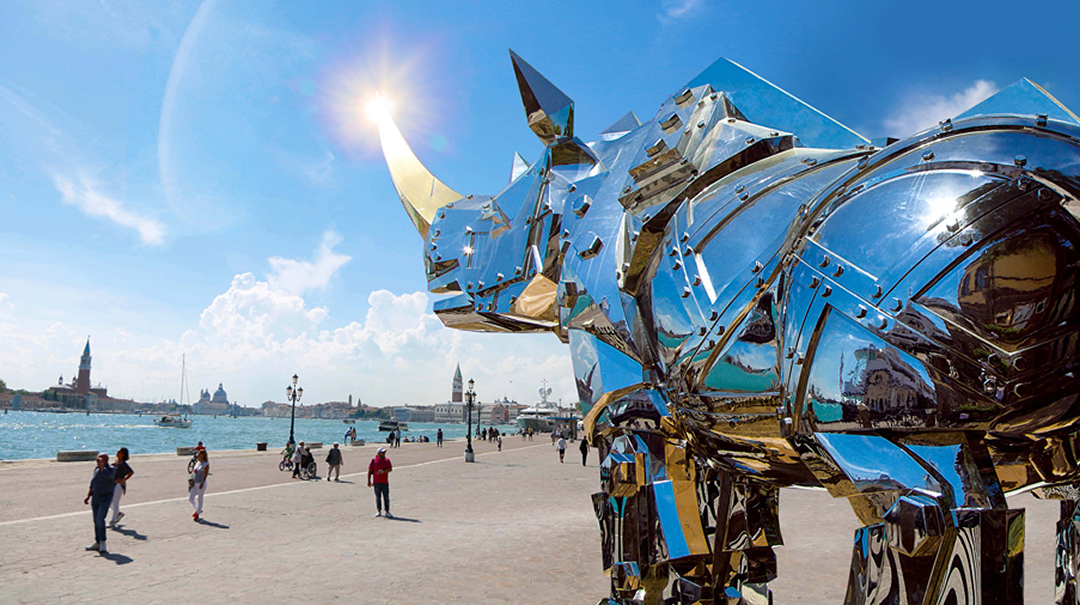
Once a sculpture enters public space, it no longer belongs to a single moment. It belongs to mornings and evenings, to seasons, to weather, and to generations of people who encounter it in passing.
In that sense, sculpture is less about the present than about continuity.
Q. Your work is often associated with an “Eastern sensibility,” yet it resonates internationally. How do you see this position?
In developing the rhinoceros works, I did return to many historical references within Chinese civilization.
In early China, the rhinoceros was not an unfamiliar being. From bronze-age ritual objects—such as rhinoceros-shaped vessels used in ceremonial contexts—to mythological records like the Classic of Mountains and Seas, it appears as part of a worldview shaped by order, reverence, and the relationship between humans and the cosmos.
There are also cultural idioms such as “the rhinoceros gazing at the moon,” which is not simply about an animal but about a way of looking—how one aligns oneself with nature and with what lies beyond immediate grasp.
Later, in Bassano del Grappa, I saw Albrecht Dürer’s 1515 rhinoceros print in the museum. I felt genuine admiration. Dürer never saw a real rhinoceros; he worked from descriptions, yet produced an image that became deeply representative in Western visual memory.
For me, this is not a matter of comparison. It is a reminder of what artists do: through understanding and imagination, an image can cross distance, time, and limits of direct experience.
If my work resonates across cultures, I believe it is not because it is “Eastern” or “Western,” but because it touches shared human experience—how we face nature, strength, restraint, and survival.
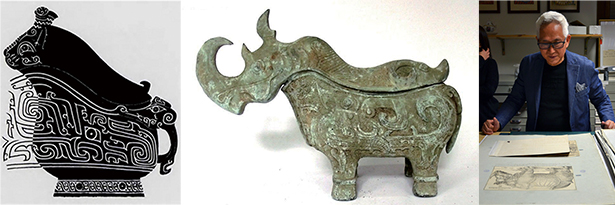
Center: Shang dynasty rhinoceros vessel (觥).
Right: SHIH Li-Jen viewing Albrecht Dürer’s 1515 Rhinoceros print in Bassano del Grappa.
Photo © Modern Art Gallery.
Q. Many of your works are installed in public space rather than enclosed museums. Why is that important?
Public space removes hierarchy.
In a museum, viewers often arrive prepared. In public space, people meet a sculpture in daily life—on the way to work, in a moment of distraction, or by chance.
I value that unplanned encounter. It allows sculpture to coexist with people, rather than stand above them.
Q. Do you expect viewers to understand the philosophical or ecological ideas behind the work?
I don’t expect everyone to understand it in the same way.
Each viewer brings different experiences and feelings. That difference is not a problem—it is part of what completes the work.
Q. In a time of ecological crisis and accelerating technology, what role can art play?
Art cannot solve problems directly.
But it can slow us down—slow enough to notice what is happening, and to consider consequences before speed turns into harm.
Q. If you had to describe your practice in one sentence, what would it be?
For me, art is a quiet, patient way of carrying the weight of civilization—without judgment, and with endurance.
Credits
Interview conducted and edited by Modern Art Gallery. © Modern Art Gallery. All rights reserved. Please contact the gallery for reprint permissions.
“Interview with SHIH Li-Jen: The Rhinoceros as a Contemporary Totem,” Modern Art Gallery, updated 2025-12-26.
Related: Artist profile — SHIH Li-Jen · Public Projects