Why the Rhinoceros?
SHIH Li-Jen’s Contemporary Totem of Civilization
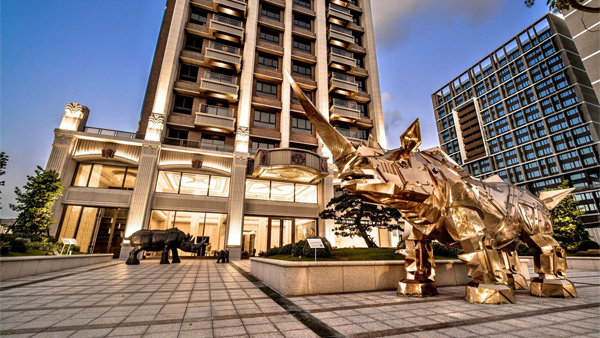
When encountering SHIH Li-Jen’s sculpture, the first sensation is often one of force: the tension held within a monumental body, the firmness of stainless steel, and the upward thrust of the rhinoceros horn. Yet to stop at the admiration of power is to miss the deeper question beneath the metal surface. For Shih, the rhinoceros is not an animal used to glorify strength. It is a life form marked by civilization’s wounds, and a silent presence that turns its gaze back upon human society.
Shih’s choice of the rhinoceros as a lifelong motif emerges from a keen sensitivity to the condition of the contemporary world. The rhinoceros is powerful yet endangered; ancient in its lineage, yet increasingly vulnerable in the modern age. Its silent body bears the traces of human desire, violence and exploitation. Once transformed into sculpture, the rhinoceros is no longer merely an animal from the natural world. It becomes an allegory of civilization: how do human beings understand primal force, and how do we confront the damage we have inflicted upon nature?
The wound beneath strength
In common imagination, the rhinoceros is often seen as an embodiment of wildness, defense and brute force. Shih looks beyond this exterior. What he perceives within the animal’s physical power is vulnerability. The rhinoceros appears invincible, yet it becomes helpless before the violence of human greed. This contradiction gives his sculptures their emotional gravity: the animal is at once a witness to ancient life and a victim of modern brutality.
The direction of the work is therefore not conquest, but guardianship. When Shih’s rhinoceroses, cast in bronze or shaped in stainless steel, enter city squares, parks and public spaces, they do not summon aggression. They open a possibility for rethinking the ethics of life. This is the first key to understanding Shih’s artistic language.
The fingerprint horn: a mark of responsibility
One of the most humanizing symbols in Shih’s work is the concentric fingerprint placed at the front of the rhinoceros horn. In the real world, the horn has often become the site of violence, driven by superstition, trade and desire. Shih does not avoid this wound. Instead, he transforms it into an ethical sign.
The horn is shaped with the suggestion of an upward thumb, while the fingerprint pattern marks the uniqueness of life and the inescapable trace of human intervention. Through this gesture, the most pointed instrument of force is transformed into a mark of responsibility. When viewers look directly at the fingerprint, the rhinoceros is no longer a distant creature from the wilderness. It reminds us that humanity is always present, and that our involvement in the ecological system cannot be denied.
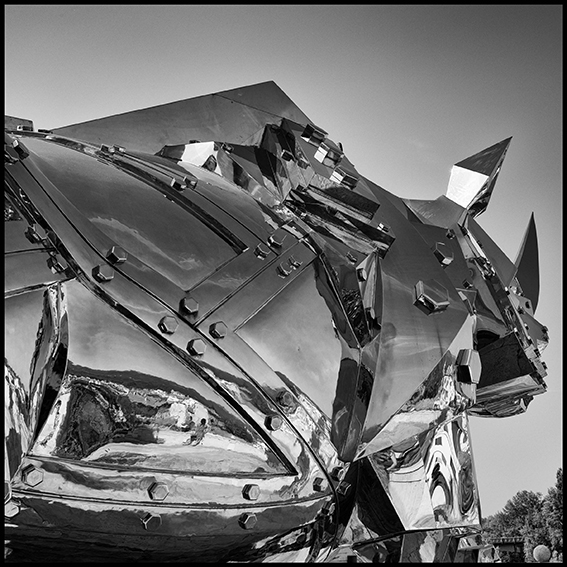
This treatment gives the work a double nature. The sculpture retains the animal’s wild outline, yet it is inscribed with human consciousness. This ambiguous state between nature and artifact is among the most compelling aspects of Shih’s work. The rhinoceros becomes a counterpart to civilization, reflecting how human beings treat the living world.
A reflective body in motion
In Shih’s hands, metal is never merely a cold industrial shell. In the King Kong Rhino series in particular, mirrored stainless steel creates an immediate relationship between the sculpture and its surroundings. Sky, clouds, buildings and passing figures are absorbed into the surface of the work. The sculpture is no longer a fixed and isolated object, but a body that breathes with time and place.
This gives public sculpture a deeper meaning. It is not decoration placed within a site; it produces a new experience of seeing. Standing before the rhinoceros, viewers encounter themselves and the city reflected together across the metal skin. The rhinoceros becomes a quiet mediator between people, nature and architecture.
From image to contemporary totem
The continuing vitality of Shih’s rhinoceros lies in its totemic quality. A totem is not merely a sign; it gathers memory, value and belief. From the familial tenderness of the Rhino Family to the guardian-like presence of King Kong Rhino, Shih’s series form an artistic system that joins natural history, cultural memory and public spirit.
This explains why the artist repeatedly returns to the same subject. For Shih, the rhinoceros is an inexhaustible language. It can shift in scale, enter daily life, address public space, and still hold its place within international discourse. This elasticity makes the rhinoceros one of the most recognizable symbolic forms in his sculpture.

A guardian presence in public space
Once sculpture leaves the gallery and enters public space, its life is no longer defined solely by the artist. King Kong Rhino possesses a strong visual presence. Even viewers unfamiliar with its art-historical context can immediately sense its stillness, gravity and protective force.
Yet in becoming accessible to the public, the work does not lose its depth. It brings together ecological crisis, East Asian cultural symbolism and the aesthetics of metal sculpture. This balance allows the work to speak to viewers at different levels. It can function as an urban landmark, while also remaining a cultural event that invites reflection.
An artistic question beyond geography
Shih’s practice offers a path for understanding contemporary Taiwanese sculpture beyond geographic labeling. He does not rely on obvious local symbols. Instead, he works through an animal image that carries global resonance, using it to address a condition shared by all human beings.
If strength is no longer used for conquest, can it become protection? In an era of accelerated technology, how can art restore reverence for life? These questions allow the rhinoceros to move beyond form. It stands between history and the future, reflecting the world through its mirrored surface and reminding us of responsibility through the fingerprint horn.
This is not simply a totem of life, but an allegory of civilization. It reminds us that true power is not measured by domination, but by the capacity to protect.
FAQ
Why does SHIH Li-Jen choose the rhinoceros as his central subject?
The rhinoceros represents both primal strength and endangered vulnerability. Shih uses this figure to reflect on humanity’s intervention in nature, transforming the animal into a symbol of ecological responsibility and civilizational reflection.
What does the fingerprint on the horn mean?
The fingerprint represents the uniqueness of life and the trace of human presence. It transforms the horn, traditionally associated with force or aggression, into a sign of ethical responsibility and coexistence.
Why does Shih use mirrored stainless steel?
Mirrored stainless steel allows the surrounding environment, light and viewers to enter the work. The sculpture becomes an open public field, dissolving the boundary between artwork and world.
Is SHIH Li-Jen a Taiwanese sculptor?
Yes. SHIH Li-Jen is a Taiwanese sculptor and public artist known for his long-term exploration of the rhinoceros as a contemporary totem, especially through the King Kong Rhino series.