Steel with a Benevolent Heart: Life Totems & the Practice of Will in Shih Li-Jen’s Sculpture
— From dynamism and ritual-vessel revival to cosmic minimalism
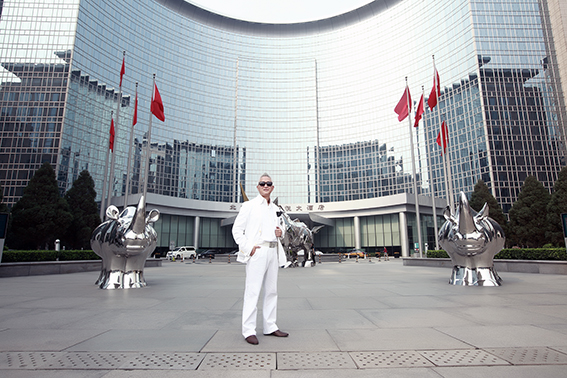
Introduction: “Shih / Li / Jen” — A Civilizational Practice of Public Sculpture
In the landscape of contemporary public art, SHIH Li-Jen (施力仁) charts a distinctive arc—from personal awakening to a sense of collective responsibility. His practice can be read through a three-part structure embedded in his name: Shih (施), Li (力), and Jen (仁). Li is the skeletal force of structure—echoing modernism's pursuit of mass and spatial tension. Jen is an ethical warmth rooted in East Asian thought, extending care toward home, ecology, and the shared human world. Shih signals enactment: the ability to translate archaeology and philosophy into a sculptural language that communicates with the public.
Here, “Shih / Li / Jen” becomes more than a signature; it functions as an operative sequence: Act (Shih: intervention), Force (Li: structural support), and Empathy (Jen or Ren: moral destination). This triad offers a lucid model for how sculpture enters an environment—not as decoration, but as a civic gesture.
Interwoven, these forces turn metal beyond material accumulation into a method of rebuilding meaning. In a time shaped by digital dematerialization and postmodern fragmentation, Shih returns to materiality—bronze and stainless steel—as a site where the spirit can be anchored. His question is direct: what should an artist leave for the future? Must human civilization be measured only by violence? By choosing metal of extreme hardness, he places a durable testimony within the flow of time.
Chapter 1: Calligraphic Force and the First Awakening of Form
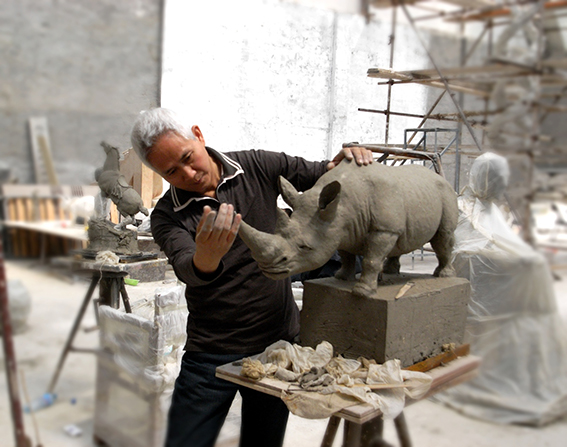
Shih's study of force begins with what is invisible: the pressure of the hand. As a child, he practiced calligraphy daily. In the rise and fall of the brush—pressing, lifting, pausing—control of weight became muscle memory. For Shih, writing is an origin of structure. Sculpture, later, becomes the expansion of that internalized force from a tabletop scale into the open air of three dimensions.
When line transforms into volume, his technique aligns with a Rodin-like pursuit of living texture. The hand presses, kneads, and articulates—so that intention enters matter and the surface holds a rocky vitality. Even in metal, the work retains a warmth: the pulse of the artist's touch is preserved as a lasting skin.
Early paper-cut experiments further sharpened his sense of void and support. Ordinary paper, folded and cut, can suddenly bear weight—a lesson in how emptiness becomes structure. This intuition—moving from plane to volume, from hollow to load-bearing—stays with him when he later commands steel at monumental scale.
Shih's early animal studies trained his eye for balance between anatomy and spatial force. Yet the rhinoceros became central after a moral shock: reports of poachers mutilating living rhinos to harvest horns. Out of grief, he intervened symbolically. He replaced the horn with a humanized form—a “thumb”—and inscribed a concentric fingerprint motif near its front, turning the horn into a sign of singular life. This paired emblem—thumb and fingerprint—became a constant across his evolving series: a totem of continuity.
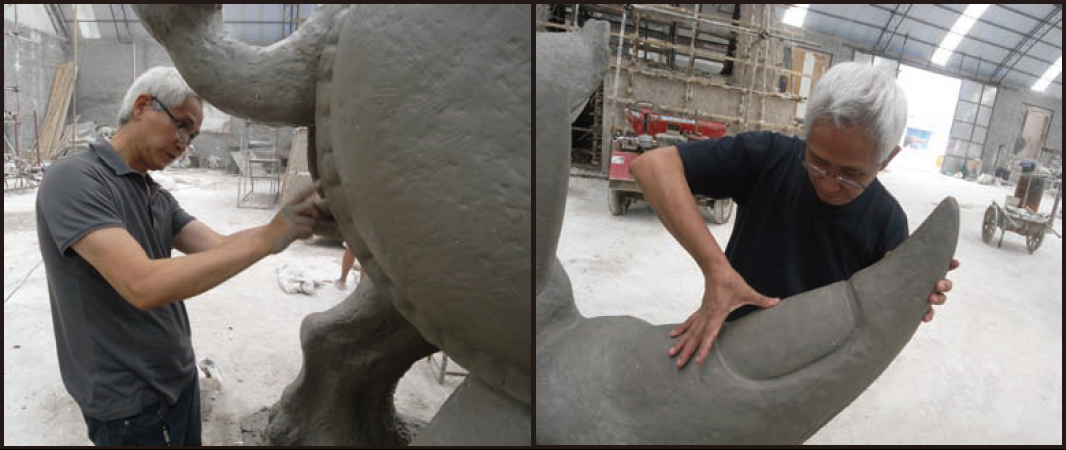
From a posthuman perspective, such substitution might appear contentious. But its intention is not human domination. It is a confession of civilizational debt: the artist acknowledges humanity's role as perpetrator and converts a distinctly human mark into a vow of protection. The symbol shifts from power to reciprocity.
Chapter 2: Recovering Lost Memory — From Ritual-Vessel Revival to Critical Realism
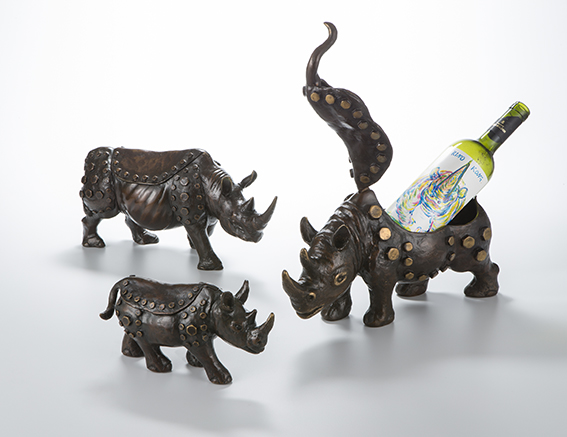
The work begins with compassion, then deepens into cultural archaeology. Shih draws on vernacular stories such as “the rhinoceros gazing at the moon,” on mythical beasts in the Classic of Mountains and Seas, and on Shang–Zhou ritual bronzes (including historical rhino-shaped vessels). Personal grief finds an unexpected resonance with ancient memory.
In the Rhino Vessel series, he revives the logic of the zun as a medium of offering. By “opening” the rhino's back, he breaks the boundary of a sealed mass and introduces permeability. This gesture echoes Henry Moore's exploration of piercing the sculptural body, while in East Asian aesthetics it aligns with a cosmology of mutually-generating void and solid. The vessel becomes a carrier of breath and spirit—a conduit between human and world.
The later Yuanbao Rhino further develops this logic of openness. The work invites multiple readings: frontal mass like a ridge; from the side, a rounded ingot (yuanbao). Limbs are simplified into a stable, tripod-like bearing structure, while a generous belly suggests capaciousness. Through repeated “opening,” Shih turns heaviness into a participatory field—shifting from biological form to cultural symbol.
The thumb and fingerprint motif evolves into a cross-temporal cultural gene. Like bronze ornament, the spiral imprint registers the pulse of life. Yet revival is not nostalgia. As Shih's works toured Europe, ecological crisis became explicit. In Venice (2017), a carpet of fallen leaves and a vivid red horn foregrounded nature's fragility; in Salzburg, No Trade, No Harm used banknotes and red-black pigment to indict extractive desire. His practice moves toward a form of critical realism: sculpture as witness and warning.
Chapter 3: Torch and Steel — The Peak of Dynamism as Civic Prophecy
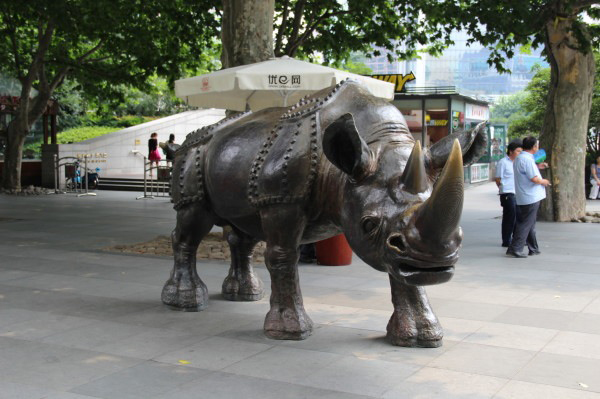
In 2010, amid the Shanghai Expo's civic reimagining, Shih presented Run to Victory—a work of strong impact and mass. The sculpture was later collected and installed at the entrance of Jing'an Park on Nanjing West Road. Between towers and temple gardens, it settles into the city as a cultural landmark.
The form holds a Baroque tension: a body poised to surge, yet grounded by steady limbs. Shih preserves traces of hand pressure on the bronze, producing a bark-like, geological texture. This tactile surface gives metal an earthbound density, as if the body still breathes.
As the patriarch of the Rhino Family, the “Rhino Dad” assumes a guardian role—answering other family figures within the park. Rivets—industrial symbols—are embedded into a warm corporeal mass, turning hide into armor. Flesh is not erased; it is protected.
A key visual pivot appears at the tail, transformed into a torch-like flame. The image sparks dual associations: the Eastern “fire-ox” charge of breakthrough and the Promethean fire of civilization. Years later, the motif crossed into reality: in 2026, during an Olympic torch relay in Italy, the procession passed beside King Kong Rhino. In that instant, flame and mirror-finish steel echoed one another—static sculpture illuminated into a historical testimony.
Chapter 4: Family, Care, and a Civic Map of Civilization
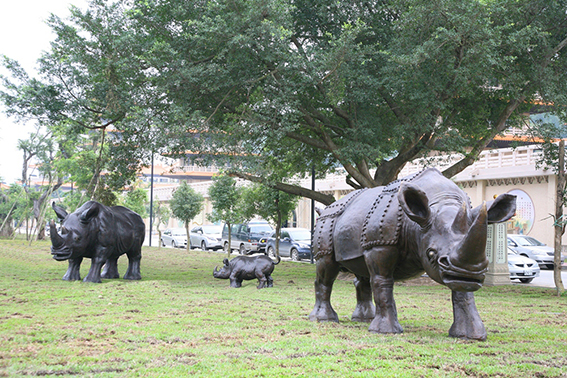
Beneath Shih's steel narrative runs a warmer current: a vigil for the basic unit of life—family. Initiated in 2006, the Rhino Family series anchors “Jen” as something tangible and shareable in public space.
Unlike Pop's logic of repetition and flattening, Shih gives each family member a distinct physiognomy: the father as mountain-like stability; the mother as rounded abundance; the children as lively facets of innocence. Within a single lineage, individuality is preserved—an answer to industrial standardization.
From this origin, his rhino vocabulary branches outward into multiple stylistic “surnames”: weathered realism, clean geometric facets, and later, futuristic mechanical constructions. Though forms vary, the source remains shared—an archive of collective memory embedded in civic life.
The “Shih” in his name becomes an ethic of giving—of placing meaning into the world. Through rhinos as civic companions, Shih builds a quiet network of “harmony without sameness.” Compassion becomes a durable will: a long guardianship over land, community, and the shared conditions of life.
Chapter 5: Geometric Purification of Will — King Kong Rhino as a Cross-Temporal Question
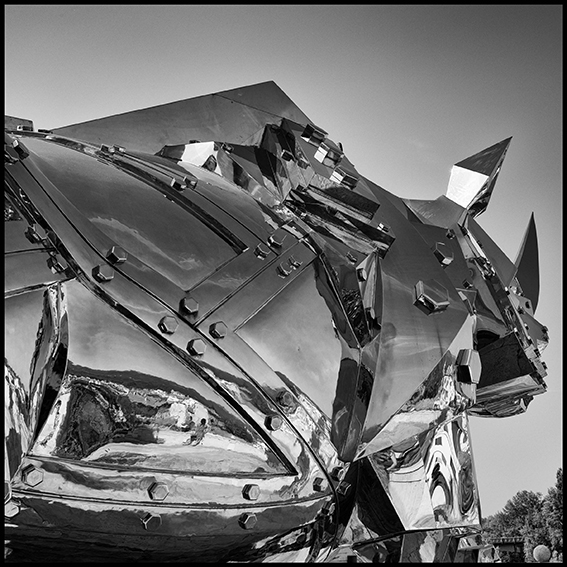
Photo: @originalbuddhasamurai
When the rhino sheds bronze patina and takes on mirror-finish stainless steel, Shih reaches a distilled articulation of will. Facing global ecological fracture, he builds an armor of geometry—yet the core is not aggression. It is protection.
The work borrows the hard-edged cuts of Futurism, but reverses its historical intoxication with war. Shih retains mechanical dynamism while redirecting it toward an ethic of safeguarding. The result is a potent tension: radical form paired with benevolent intent.
Diamond-like lines replace organic folds; the simplified body still carries a dense civilizational memory. Facial cues recall the otherworldly presence of the Sanxingdui culture, granting the metallic body an ancient, vigilant gaze. The rhino is no longer a silent beast but a sentinel—reinstating a sense of the sacred within contemporary spectacle.
Details act as anchors of will: a secondary horn condensed into a pyramid-like point; the main horn animated by concentric fingerprint rings, synchronizing individual intent with a larger cosmos. The tail, evoking a vajra-like stabilizer, suggests balance—strength held to an axis of compassion.
This is not postmodern collage but a spatialization of “civilizational simultaneity.” Shih stages a synthesis: awareness (Sanxingdui), steadiness (pyramidal order), action (fingerprint), and balance (vajra). In a fractured age, the ambition is wholeness.
Unlike slick consumer surfaces that erase trace and subject, Shih's stainless steel acts differently: the mirror finish absorbs the world into the work's order. It is a reverse incision—a sacred viewpoint inserted into the landscape society. Armor becomes shield. The work answers Shih's question: civilization's highest form is not conquest, but the guardianship that follows strength.
Chapter 6: From Mythic Beast to Everyday Companion — Neo-Pop Humanity and a Celebration of Life
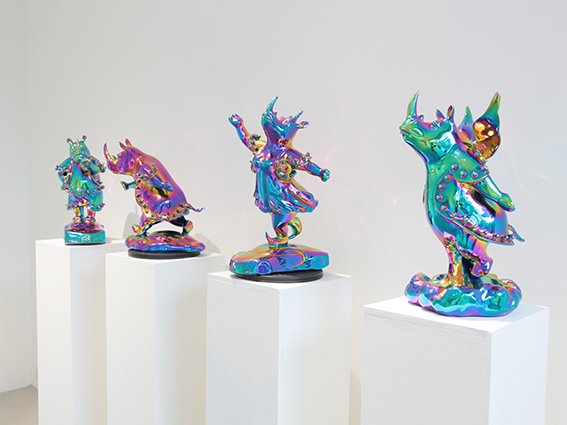
After the austerity of steel will, Shih's gaze warms. The solemn geometry of the King Kong series softens into a rounded Neo-Pop language. If King Kong Rhino is armor against pain, the Cute Rhino series is what follows healing: ease, play, and human closeness. Monumentality returns to daily life; sculpture becomes a companion rather than a monument.
In art-historical terms, the expanded volume recalls Fernando Botero's amplified corporeality. Shih turns metal's hardness into the illusion of breathing skin. Energy pushes outward; the body shifts from “readying” to “resting”—from confrontation to fullness.
The series traces four phases of life: Steps Forward (first courage), Pop Dance (raw joy), Soaring Up (aspiration), and At Ease (completion). Even in the most playful forms, the thumb-horn and fingerprint remain—life's signature protected by humor.
This shift closes the distance between contemporary art and the public. Compared to the ritual gravity of Rhino Vessel, the Cute Rhinos shed civilizational burden. If King Kong Rhino guards the city like a war-deity, Cute Rhino meets children at the street corner as a gentle neighbor.
This “laying down of armor” marks a return from spectacle to lived reality. Sharp edges evolve into rounded curves that awaken protective instinct—an emotional adaptation: in an industrial jungle, tenderness can be the most effective call to compassion, securing cultural continuity for endangered life totems.
Here, hierarchy dissolves. People laugh, touch, and converse freely. Public art becomes truly public. Shih opens a humane oasis within the metallic topography of modernity—where kindness and play are not trivial, but necessary.
Chapter 7: Toward the Cosmos — Rise of the Planet and the Minimal Horizon of Spirit
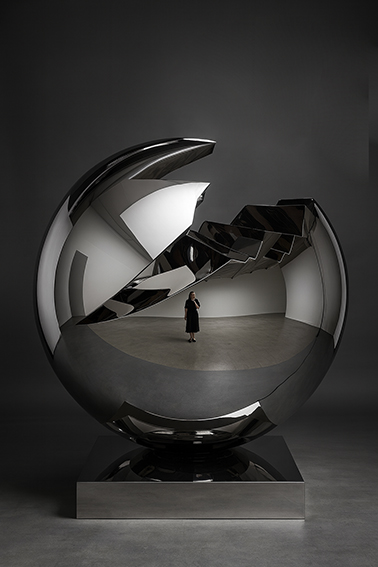
Finally, Shih's vision breaks free of gravity and turns from earth to the cosmos. Rise of the Planet elevates heavy metal into a minimalist field where Zen-like sensibility meets geometric completion. The rhino recedes into a quiet outline, echoing an East Asian principle of “withholding form to reveal spirit.” Materiality flips into spirituality.
The highly polished surface becomes more than a finish—it is a mirror for inner reflection. Cloud, dusk, and the viewer's silhouette meet on the sphere and stretch along its curvature. Boundaries soften; self and world interpenetrate. Perception becomes an exchange of energy.
This “capacity to contain” enacts a philosophy of wholeness. In the act of seeing oneself, one also resonates with the larger universe—life as continuity. The work is no longer a mass that occupies space; it becomes an energy field that dances with light, transmuting personal grief into a macro-compassion for all beings.
Conclusion: A Civilizational Ark Sailing into the Future
Across Shih's oeuvre, one question persists: how can life endure through sculpture? His rhino becomes an ark of civilization—at times a ritual vessel carrying memory, at times a family guardian sheltering intimacy, at times steel resisting shock, at times a companion that sings and dances, and finally a spiritual sign beneath the stars.
From the Venice Biennale to the time-bridge dialogue with Dürer in Bassano del Grappa, Shih advances a credo of reappearance and continuity. Shih is enactment, Li is structural force, Jen is the warmth of spirit. Before these upward-facing bodies, we witness craft at its highest precision—and the artist’s ultimate pledge: not the conquest of nature, but the protection that must follow strength. In the reflection of King Kong Rhino, the world sees both courage and tenderness—an enduring will to settle and shelter life.