

藝術家簡述|Artist Overview
成長背景|Origins and Formation
黃鋼1961年出生於北京,童年到青年時期正值中國社會劇烈變動的年代。由於家庭背景的影響——父親為中國藝術史教授,母親為文物鑑定家——他自小接觸中國傳統藝術,並學習繪畫與書法。這樣的成長背景,使他很早便意識到文化傳承與歷史經驗之間的緊密關係。
Born in Beijing in 1961, Huang Gang came of age during a period of profound upheaval in Chinese society. His father was a professor of Chinese art history, and his mother a specialist in cultural relic authentication. Immersed early in traditional Chinese art, he studied painting and calligraphy from childhood, forming a lasting awareness of the relationship between cultural inheritance and historical experience.
1980年,他以優異成績考入中央工藝美術學院。彼時中國正處於改革開放初期,伴隨對文化大革命的反思,整個文化界興起了對自由表達與思想啟蒙的強烈渴望。身在其中的黃鋼,深受那股時代精神吸引,也由此確立了自己作為藝術家的理想方向。
In 1980, he entered the Central Academy of Arts & Design. China was then entering the early phase of reform and opening-up, when reflection on the Cultural Revolution gave rise to a broader search for freedom of expression and the social role of art. Huang Gang was deeply drawn to that atmosphere, and it was in this context that he defined his artistic ambition.
創作轉向|From Calligraphy to Tibetan Cultural Material
黃鋼早期曾創作以中國書法為核心的繪畫作品。對他而言,書法並不只是文字,而是中國傳統文化中宇宙觀、哲學與精神氣質的凝聚形式。他在畫面中削弱文字原有的可辨識性,轉而強調書寫的節奏、筆觸的力道、線條的流動與構圖的秩序,使書法在當代視覺語境中轉化為帶有東方精神特質的抽象表現。
Huang Gang’s early works were rooted in Chinese calligraphy. For him, calligraphy was not merely linguistic form, but a condensation of cosmology, philosophy, and spiritual temperament within Chinese tradition. By reducing legibility and foregrounding rhythm, gesture, movement, and compositional structure, he transformed calligraphy into a contemporary visual language charged with distinctly Eastern sensibility.
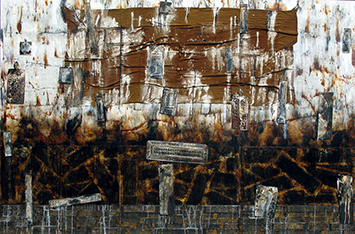
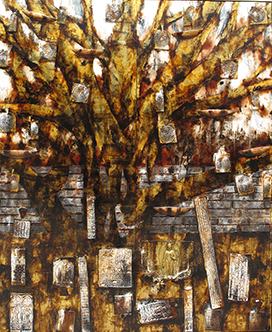
自八十年代起,他對西藏文化、宗教與藝術產生濃厚興趣,並開始收藏與研究西藏古典繪畫與佛經印版。此後,他的創作題材與材料都產生明顯轉變:木刻佛經印版、手抄佛經、古老毛牛皮箱、礦物顏料、丙烯、大漆、金箔與宣紙,成為作品中的重要構成。這些材料本身已帶有深厚的歷史與精神性,在他的再組構之下,不再只是宗教遺物,而成為與當代人生活、思想與焦慮發生關係的藝術語言。
From the 1980s onward, he developed a sustained engagement with Tibetan culture, religion, and classical art, collecting and studying Buddhist print blocks and related objects. His work subsequently shifted in both subject matter and material vocabulary: carved sutra blocks, handwritten scriptures, old yak-hide trunks, mineral pigments, acrylic, lacquer, gold leaf, and xuan paper became central elements. In his hands, these materials cease to function as relics alone; they become active vehicles through which historical spirituality enters into dialogue with contemporary life and anxiety.
作品內在結構|Conflict, Reconstruction, and Human Concern
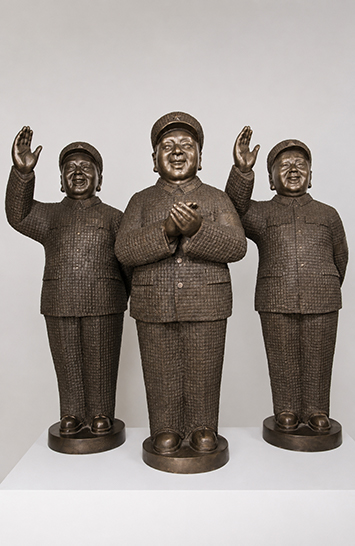
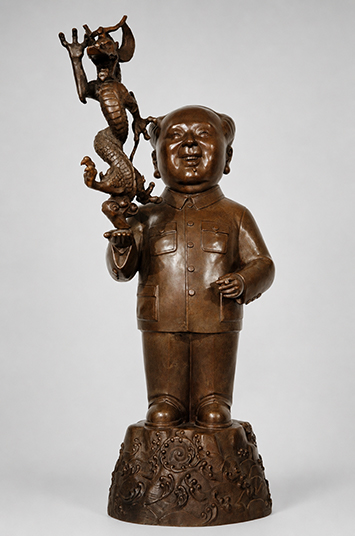
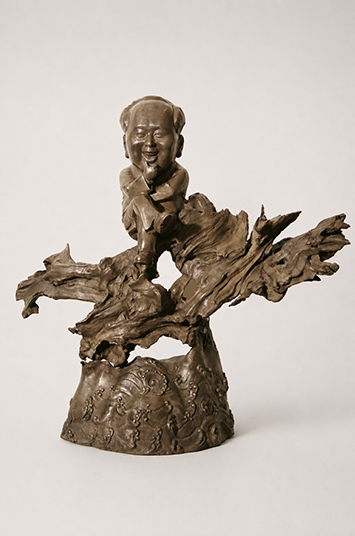
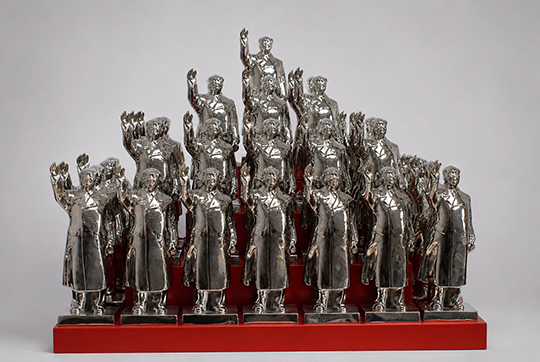
黃鋼的創作並不直接訴諸宗教圖像的崇高感,而是將古老思想文化與現代文明之間的差異、矛盾與衝突,轉化為一種具有強烈張力的視覺場域。他的作品常在平靜與激烈、精神性與荒誕感之間展開。革命符號、佛經印版、箱子、人物與歷史形象,在同一畫面或結構中並置,使作品成為一種構建、破壞、再構建的過程。
Huang Gang does not simply invoke the sacred aura of religious imagery. Instead, he turns the differences, contradictions, and collisions between ancient cultural systems and modern civilization into a charged visual field. His works often unfold between calm and intensity, spirituality and absurdity. Revolutionary symbols, Buddhist print blocks, trunks, figures, and historical references are brought into unstable proximity, making each work a process of construction, rupture, and reconstruction.
這樣的藝術語言,也回應了他自身所經歷的時代:從文革陰影、改革開放,到全球文化格局中東方價值如何自處的問題。黃鋼始終關注的不只是形式實驗,而是人在社會變動中的精神狀態,以及藝術如何在歷史與現實之間保有獨立思考與人文關懷。
This language of art reflects the historical conditions through which he has lived: from the shadow of the Cultural Revolution to the upheavals of reform, and the broader question of how Eastern values retain their distinctiveness within a global cultural order. For Huang Gang, form is never an end in itself; what matters is the human condition under social transformation, and the capacity of art to sustain independent thought and human concern.
Selected Works|作品欣賞



媒體與報導|Press & Publications


獎項與展覽|Awards, Collections, and Selected Solo Exhibitions
黃鋼於1991年獲平山鬱夫獎,1995年於第一屆北京國際環境藝術展獲銀獎。其作品曾為鑄造博物館、凱旋藝術空間與亞洲藝術中心等機構收藏;並於北京、德國、香港、日內瓦、巴黎、聖塔菲、台北、保利藝術博物館與上海美術館等地舉辦個展。
Huang Gang received the Ikuo Hirayama Award in 1991 and the Silver Prize at the First Beijing International Environmental Art Exhibition in 1995. His works have entered collections including the Casting Museum in Beijing, Triumph Art Space, and Asia Art Center, and have been presented in solo exhibitions across Beijing, Germany, Hong Kong, Geneva, Paris, Santa Fe, Taipei, Poly Art Museum, and the Shanghai Art Museum.