From Gallery Founder to Mr. Rhino:
The Artistic Life of SHIH Li-Jen

SHIH Li-Jen is a Taiwanese contemporary sculptor, founder of Modern Art Gallery, and creator of the iconic King Kong Rhino series. His artistic life spans gallery leadership, international art promotion and public sculpture, forming a rare cross-disciplinary path within Taiwan’s art world.
SHIH Li-Jen’s life cannot be contained within a single label. For decades, he stood at the forefront of Taiwan’s art scene—running a gallery, organizing exhibitions, introducing international masters and witnessing the early formation of modern art collecting in Taiwan. After reaching the age of sixty, he turned his gaze inward and began to shape a sculptural path of his own, with the rhinoceros as his spiritual totem. The transition from art promoter to the widely recognized “Mr. Rhino” was not a departure from his past, but the concentrated release of decades of aesthetic experience.
Seen in retrospect, Shih’s artistic practice did not emerge by chance. Moving among artists, collectors and international exhibitions, he developed an acute intuition for artistic language, material presence, the spirit of an era and the psychology of viewers. Those experiences did not remain confined to gallery management. They gradually settled into the core perspective that would later shape his sculpture.
A sensibility rooted in Taiwan
Shih was born in central Taiwan. This land gave him a temperament marked by directness, resilience and a deep sense of human connection. The childhood memory of looking up at the Great Buddha of Baguashan left an early impression of monumental volume and spatial presence. The cultural atmosphere of central Taiwan also nourished his later commitment to promoting art.
This rootedness shaped him deeply. His attachment to land and home would later reappear in his sculpture as a concern for guardianship, ecology and the protection of life.
Modern Art Gallery and the contemporary art scene
Before he took up sculpture, Shih was best known as a gallery owner and art promoter. In the early 1980s, he founded Modern Art Gallery in Taichung, now among Taiwan’s long-standing gallery institutions. At a time when the local art market was still developing, the gallery promoted both senior Taiwanese artists and contemporary voices, while also acting as a cultural bridge between Chinese modern art and Western modernism.
Shih introduced and promoted major Chinese artists such as Zao Wou-Ki and Chu Teh-Chun, while also bringing works by Auguste Rodin, Arman and Salvador Dalí to Taiwan. The presentation of Rodin’s The Thinker in an urban context opened a wider international horizon for local audiences. Because Shih had long learned to consider artworks through exhibition space and public interaction, his own sculpture carried, from the beginning, a strong impulse to move beyond the closed studio and speak to the public.

A creative turn after sixty
Shih’s decision to devote himself to metal sculpture in the later part of life was not a late pastime, but the inevitable release of a lifetime of artistic experience. After passing on the daily operations of the gallery, creation became his way of questioning life, ecology and the conflicts of civilization.
His choice of the rhinoceros as a central motif came from compassion for endangered species and a profound critique of human greed and violence. The rhinoceros is massive, ancient and silent, yet it has been repeatedly slaughtered by human desire. Through the form of the rhinoceros, Shih found an expressive language capable of carrying both primal force and humanistic concern.
“Mr. Rhino” is therefore more than a friendly nickname. It marks a deep bond between the creator and the creature he has chosen to speak through. He lives with the rhinoceros, gives it voice, and uses it to question the world.
The rhinoceros as a totem of the age
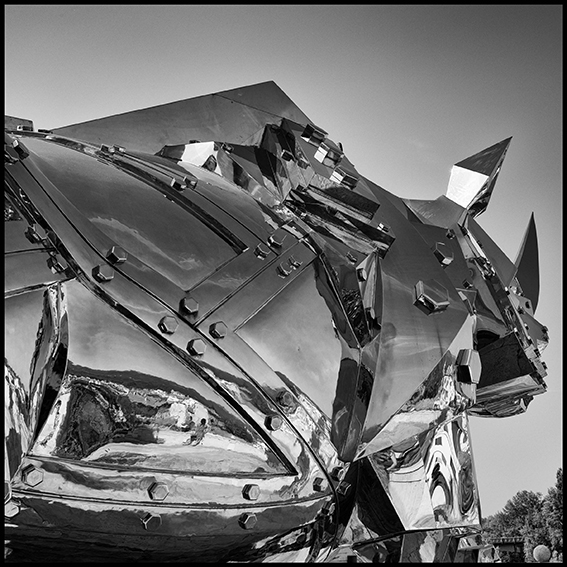
In Shih’s hands, the rhinoceros has long moved beyond realistic animal representation. It becomes a guardian of life and a witness to civilization. From the familial tenderness of the Rhino Family to the armored monumentality of King Kong Rhino, different series carry broad questions of homeland, urban development and ecological responsibility.
The fingerprint marked upon the rhinoceros horn is one of the most recognizable spiritual signs in his sculpture. Shih transforms the horn—normally understood as an instrument of defense or aggression—into a sign of human DNA, civilizational imprint and a pledged handprint for the protection of the Earth. The rivets and hard-edged structures across the massive body suggest humanity’s movement from agriculture to industry, and even toward the age of artificial intelligence. These details lift the metal body into a philosophical dimension, turning the sculpture into a mirror of human ambition and self-reflection.
Public dialogue across borders
Shih’s long experience in exhibition-making gave his sculpture a strongly public character. He understood that once a work enters the outdoors, monumentality alone is not enough. It must also have the capacity to speak to ordinary viewers and form emotional connections.
King Kong Rhino has been presented at the Marinaressa Gardens during the Venice Biennale, in Bassano del Grappa, Taipei’s Xinyi District and public sites in Shanghai. Through these appearances, Shih’s personal artistic language expanded into a cross-border cultural event. When pedestrians stop, look up and photograph themselves with the great rhinoceros, the sculpture quietly enters urban memory. This echoes Shih’s belief in the value of art: it may enter private collections, but it may also stand in the square, becoming part of contemporary society’s shared memory.
The vision of a rhinoceros art museum
Shih’s imagination of the rhinoceros has never stopped at a single sculpture or a single exhibition. He hopes that one day a physical site centered on the spirit of the rhinoceros may be established in Taiwan, bringing together art presentation, ecological education, care for life and local culture.
If realized, a rhinoceros art museum would not be merely a place for display. It would be an open platform inviting the public to reconsider the boundary between humanity and nature. Rooted in Taiwan yet facing the world, this vision carries particular significance: beginning from the artist’s own conviction, it responds to a global ecological crisis and returns humanistic art to the land that nourished it.
Looking back at civilization through the rhinoceros
From a pioneer in art promotion to a major figure in contemporary sculpture, Shih has followed a path that is rare yet deeply grounded. In the first half of life, he built bridges for international masters; in the second, he turned to welding and metal to speak for life.
His rhinoceroses stand at the edge between the city and nature. They are powerful yet marked by silent compassion; they are hard metal armor, yet also warm spiritual totems. Through the rhinoceros, Shih looks back at human civilization and guides viewers to look inward. What “Mr. Rhino” has carved is not merely the body of an animal, but an enduring imprint that questions the world.
FAQ|About SHIH Li-Jen’s Artistic Life
Why is SHIH Li-Jen known as “Mr. Rhino”?
He has long focused on the rhinoceros as his central artistic motif, developing major series such as King Kong Rhino and Rhino Family. The rhinoceros is not only his most recognizable artistic language, but also a symbol of his commitment to speaking for endangered species and ecological awareness.
How did his early gallery experience influence his sculpture?
His long engagement with international exhibitions and the art market gave him a sharp sensitivity to artistic context, spatial arrangement and public viewing. This allowed his sculpture to move beyond a closed studio perspective and develop strong public and cross-cultural dimensions.
What core ideas do the rhinoceros sculptures express?
The rhinoceros moves beyond realistic animal form to become a totem of dignity, ecological reflection and critique of civilizational violence. The fingerprint and rivet-like details suggest both human DNA and the armored transformations of history.
What is the vision behind a rhinoceros art museum?
The vision is to move beyond conventional display space by bringing contemporary sculpture, ecological awareness and local culture together, creating a sustainable public platform for reflecting on the relationship between civilization and nature.